When people think about aesthetic treatments, they tend to picture the treatment itself — the product, the technique, the result. What rarely gets the attention it deserves is the conversation that makes all of that possible: the consultation.
In my practice, the consultation is not a formality. It is not a box to tick before we get to the "real" part. It is, in every sense, the foundation on which safe, satisfying and truly personalised treatment is built.
Understanding what you actually want
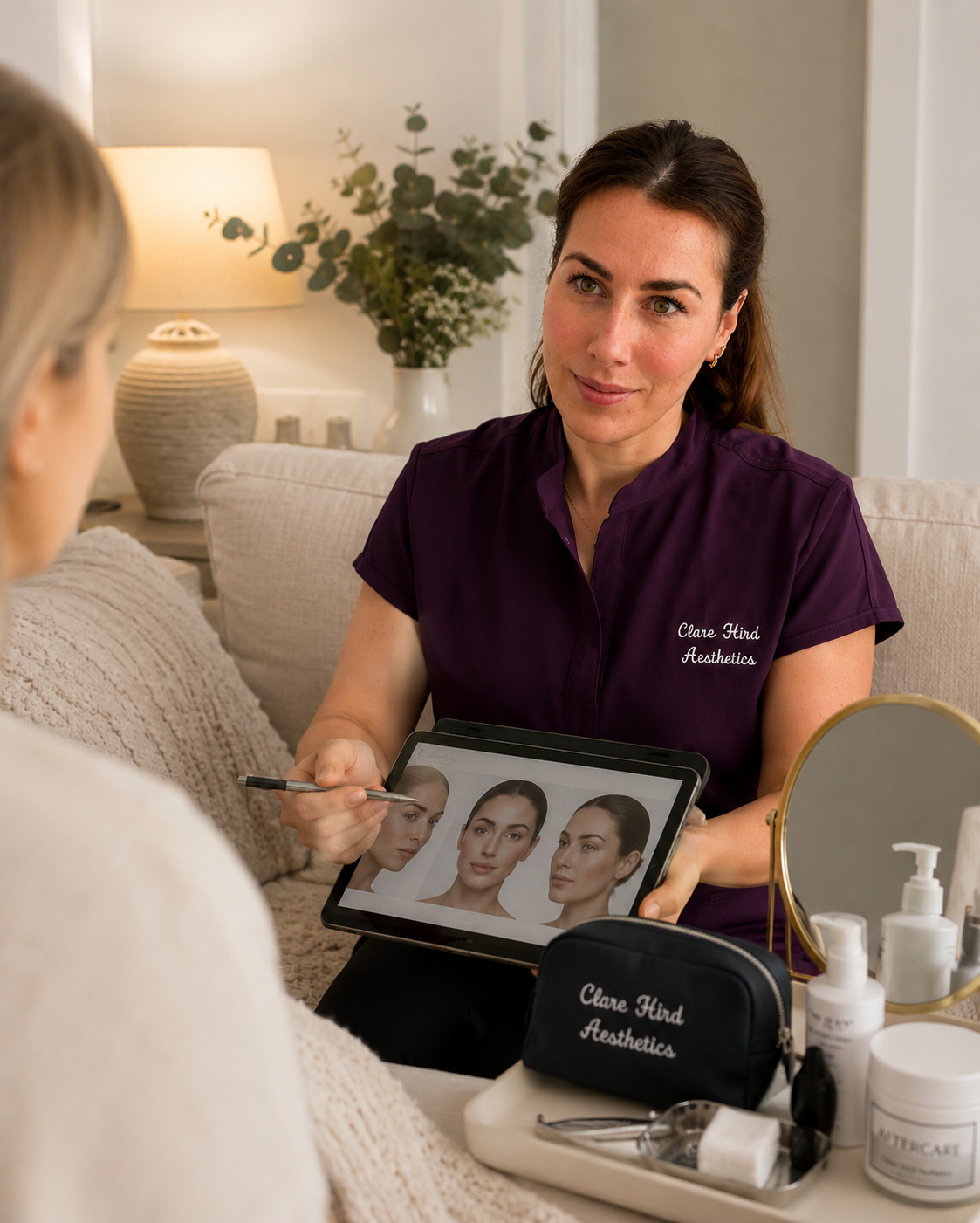
Aesthetic desire is deeply personal — and it is rarely as simple as "I want my lines softened" or "I want more volume here." Behind every enquiry is a feeling: perhaps a sense that you look more tired than you feel, or that something has shifted and you want to look like yourself again. Sometimes people arrive with a very specific goal; sometimes they simply know something has changed and they are not quite sure what they would like to do about it.
The consultation is where I listen — properly listen — before I say anything at all. I want to understand not just what area you are concerned about, but why it matters to you, how long it has bothered you, and what outcome would make you feel genuinely happy. Those are very different questions, and the answers change everything about how I approach your care.
This is also the space where I explore your areas of concern honestly with you. Not every concern has a straightforward aesthetic solution, and not every solution is right for every person. Understanding what is driving your concerns allows me to give you genuinely useful advice rather than simply recommending the treatment I happen to offer.
Setting realistic expectations
One of the most important things I can do for you in a consultation is be honest about what aesthetic treatment can and cannot achieve.
Aesthetic medicine has advanced enormously, and the results achievable with today's techniques and products are remarkable — but they are not magic. Certain structural concerns respond beautifully to treatment; others require a different approach, a longer timeline, or a frank conversation about whether treatment is the right path at all. Telling you what you want to hear might feel kind in the short term, but it would be a disservice to you.
I want you to leave your consultation with a clear, realistic picture of the process — how a treatment works, how results develop over time, what the recovery or aftercare period involves, and what your result is likely to look like. Surprises after a treatment are almost always a sign that expectations were not aligned beforehand. My goal is that you feel informed, prepared and genuinely excited — not uncertain or anxious.
"Telling you what you want to hear might feel kind in the short term. But it would be a disservice to you."
Knowing when to say no
This is, I believe, one of the defining marks of a practitioner you can trust: the willingness to decline a treatment when it is not in your best interest.
There are times when the treatment being requested is not the right treatment for the concern. There are times when a patient's expectations cannot realistically be met by any aesthetic intervention. There are times when the timing is not right — a recent illness, a period of significant emotional stress, or a life event that might be influencing how someone is feeling about their appearance. And there are times when underlying concerns need to be addressed before aesthetic treatment is appropriate.
Saying no is never comfortable. But it is sometimes the most caring and clinically responsible thing I can do. If I ever recommend against a treatment, or suggest we take more time, it is because I am prioritising your long-term wellbeing over a short-term appointment.
Why being a Nurse Prescriber matters
As an Independent Nurse Prescriber, I am qualified and legally authorised to independently assess patients, prescribe prescription-only medicines (POMs) where clinically appropriate, and take full responsibility for those prescribing decisions within my scope of practice.
In aesthetics, this matters more than many people realise. Several of the most effective aesthetic treatments are prescription-only medicines. In the UK, they can only legally be prescribed following a face-to-face consultation and clinical assessment by a qualified prescriber. A practitioner who is not a prescriber must obtain a prescription from a third party who may never have met you — which fundamentally compromises the quality of that clinical oversight.
When I prescribe, I am not simply signing a form. I am making a clinical judgement that takes into account your full medical picture: your health history, any medications you are currently taking, known allergies, previous treatments and any contraindications that might make a particular product or technique unsuitable for you.
Medical history, pharmacology & drug interactions
Aesthetic treatments may look cosmetic, but they are medical procedures, and the products used are pharmacologically active. Understanding their mechanisms of action — how they work in the body, how long they remain active, how they interact with other substances — is essential for safe practice.
During your consultation, I will take a thorough medical history. This is not a routine exercise; it directly informs every recommendation I make. Certain health conditions affect the suitability of specific treatments. Some medications interact with aesthetic products in ways that could affect both your result and your safety. And certain lifestyle factors — including sun exposure, skincare routines and previous treatments elsewhere — are all relevant to the plan I put together for you.
This level of clinical assessment is what distinguishes nurse prescriber-led aesthetic care from less regulated alternatives. It is also the reason I ask the questions I do — not to be intrusive, but because your safety depends on the full picture.
"Understanding a product's pharmacology — how it works, how it interacts — is what separates a clinical approach from a cosmetic one."
Clarity, alignment & trust
Even when the clinical picture is clear and expectations are realistic, something else needs to be in place before treatment begins: trust.
You need to trust that I understand what you are hoping for. I need to be confident that we are aligned on the goal, the approach and what success looks like. Without that mutual clarity, even technically excellent treatment can leave a patient feeling unsatisfied — not because the result was poor, but because it was not quite what they had imagined.
The consultation is where that alignment is established. It is a two-way conversation, and both voices matter. I will always invite questions, welcome uncertainty and never make you feel rushed. This is your face, your body and your decision. My role is to give you the information, expertise and honest guidance to make that decision well.
What to expect from your first consultation with me
Your first consultation with me is relaxed, unhurried and entirely without obligation. Here is what you can expect:
Your consultation — what happens
- A proper conversation first. I will ask you about your concerns, your goals and what has prompted you to consider treatment now. I want to understand your aesthetic wishes in the context of your life, not just assess your face in isolation.
- A thorough medical review. I will take your medical history, ask about any current medications and supplements, note any allergies or previous reactions and discuss any previous aesthetic treatments you have had. Everything you share with me is treated with complete confidentiality.
- An honest assessment. I will look at the areas you are concerned about with a clinical eye and give you my genuine professional view — including whether I think treatment will help, which options I feel are best suited to you, and whether there is anything I would recommend approaching differently from how you might have imagined.
- A clear, personalised treatment plan. If we agree to proceed, I will explain the treatment or treatments I am recommending, the products involved, how they work and what to expect afterwards. You will receive full written aftercare guidance and have time to ask any questions before we begin.
- No pressure, ever. If you would like time to think, that is always the right answer. A good consultation should leave you feeling clear and confident — and if you leave simply feeling better informed, that is a good outcome too.
Aesthetic treatment at its best is a collaboration built on honesty, expertise and genuine care for the person in front of you. The consultation is where that collaboration begins — and it deserves to be taken as seriously as the treatment itself.
Ready to book your consultation?
All new clients begin with a no-obligation consultation. Clare will listen, assess and give you honest, clinically led advice — with no pressure to proceed.
Book a Consultation